Fantastic Four 1234 is arguably an odd choice for my first review—for my first Fantastic Four review—on this blog, for a few reasons. The first of which is that I didn’t particularly enjoy it. The second of which is that it’s vastly different in tone and style to anything else I’ve read of the Four, and not necessarily in a good way. And the third of which is that it’s something I don’t think I’ll ever consider in my “personal canon” of Marvel comics.
This can often be the case with miniseries. Even some major runs end up being so terrible, to the point where readers agree on collective amnesia. There are certainly stories I feel that way about, which I’m sure I’ll get to at another time and in another blog post. But I digress. Miniseries are hit or miss, same with alternate universes, and comics in which characters from other series appear outside of their normal environment, being written by writers who are often inexperienced with them at best, or straight up dislike them at worst. (I’m looking at you, Captain America in X-Men comics.)
Some miniseries are a Spider-Man/Human Torch, and some miniseries are a Fantastic Four 1234.
And yet, despite my… lukewarmness towards these four issues, I can’t help but feel that I have something to say about them. They made me think. Some moments made me think hard, even the uncomfortable ones. Sometimes, especially the uncomfortable ones.
Maybe that’s why I do feel compelled to write about it as my first blog today, as a way to get to know me: I can’t take anything at face value, and I love to write about work that makes me think.
While I don’t think the plot is tight, or even particularly good, the miniseries does reveal some important and interesting details about the characters it’s working with—at times, more than runs in the main series have. The general plot follows Doctor Doom playing a mental, technological, matrix-esque game of chess to control the minds and actions of the Fantastic Four, working to try and get them to tear each other apart, but we don’t learn this until the end. As Reed describes it in the fourth and final issue: “Someone is trying to make us do all the things we’d never do.”
What we also don’t learn until the end is that all along, Reed has been playing a counter game, and that his diligence in predicting what Victor would do is what saved the day.
Reed and Autism Spectrum Disorder in 1234:
Reed is admittedly the most interesting part about this miniseries for me—not so much that he was playing the game against Victor all along, but more so how his absence as he throws himself into solitarily saving the world affects his family around him. As you can imagine, his tendency to do this, with this time being no exception, has the most profound impact on Sue.
Early on in the first issue, we see Sue on the phone with Alicia talking about Reed shutting himself away in his lab. She asks her: “Did you read that article about subtle Autism I sent you? Asperger’s syndrome…?” This is striking, and the closest confirmation we’ve had regarding Reed’s neurodivergence in Earth-616 at the time this series was published in 2001. As such, some of the ways in which Asperger’s Syndrome, now referred to as ASD (Autism Spectrum Disorder), or Level 1 / Low Support Needs ASD, is presented can feel a little outdated. In the first issue, Sue quotes the article, describing Reed’s potential ASD as “High intelligence, high achievement, lack of empathy, single-minded pursuit of solitary interests…”

Quick note: We now know that of course Autistic individuals do not lack empathy, and this has been debunked as a myth—again, this miniseries is a product of its time. This article by Medical News Today breaks down what the differences in Autistic empathy actually are.
The next time we catch up with Sue in the second issue, she’s lamenting to Alicia over wine and dinner about how she wishes Reed were different, and openly pines for another man (Namor, an on-again, off-again villain of the Four). Alicia is then the one who has to go on to remind her that Reed does love her, and does love the family—he just expresses it in a different way.
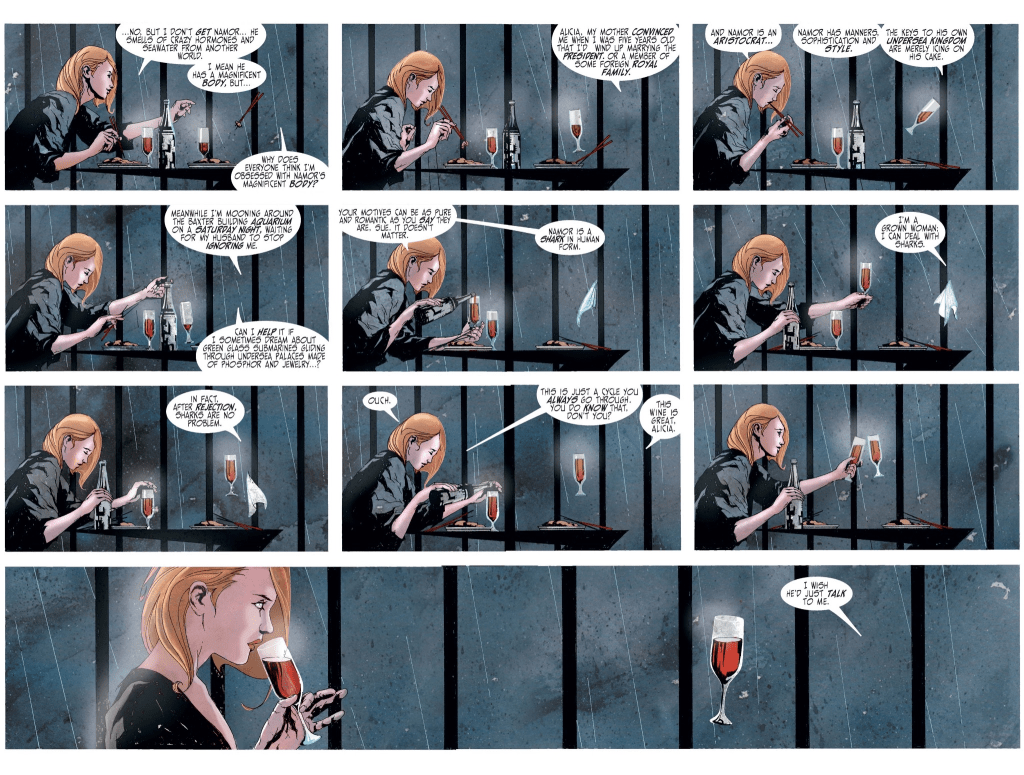
While I do feel that this whole interaction is wildly out of character for Sue, even under the manipulation of Doom, it is emotionally resonant. Many Autistic people, myself included, spend a lot of time wishing they could be different, even if they love and accept who they are. On a personal level, there are many times where I wish I could perceive the world differently, think less, or enjoy things that everyone else seems to, like going out to dinner at a nice restaurant, exploring a new, fun downtown city, dancing at a club, etc. The Autistic experience for me comes with a sense of guilt—that I’m not living life how I should be, and that this impacts both my own wellbeing, as well as the lives of those around me. It is difficult to know that something you can’t change about yourself is simultaneously the reason why the same people who love and support you can find it difficult to accommodate you, or even be around you at times.
Reading Sue lamenting that she wishes Reed were different hurts, and it hurts because it is real.
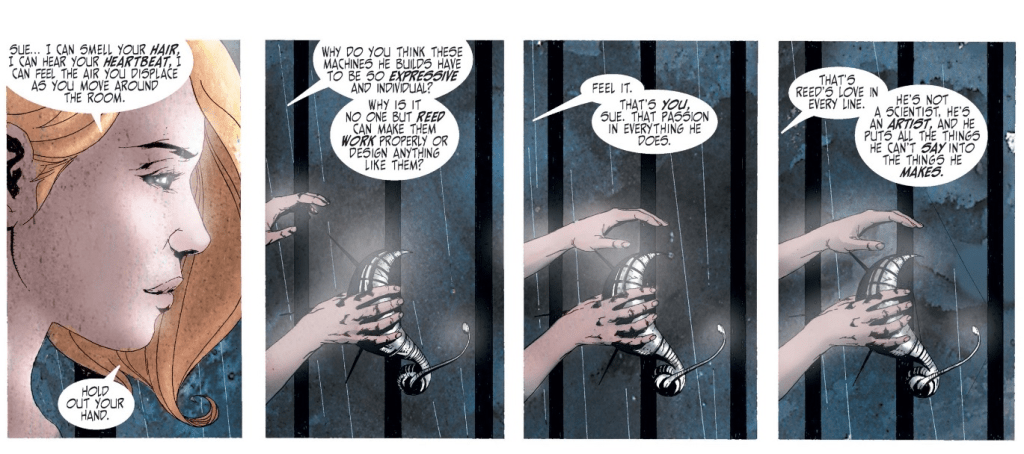
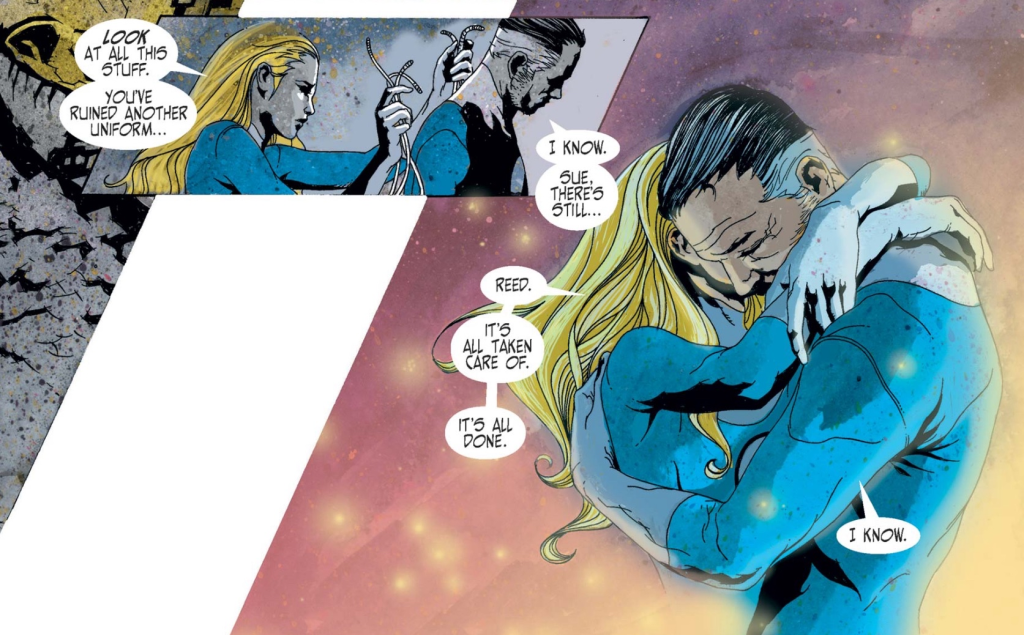
The comic concludes with a silent moment of understanding between Reed and Sue, which can be read as an unspoken apology and forgiveness. Though I do personally wish this moment was bigger, and felt that it needed more space to linger, by the end Sue realizes and accepts that Reed isn’t doing what he’s doing to hurt her. This circles back to a kind of thesis Alicia gave about Reed in the second issue, where she hands Sue one of Reed’s devices and says:
“Why do you think these machines he builds have to be so expressive and individual? Why is it that no one but Reed can make them work properly or design anything like them? Feel it. That’s you, Sue. That passion in everything he does. That’s Reed’s love in every line. He’s not a scientist, he’s an artist, and he puts all the things he can’t say into the things he makes.”
While 1234 wasn’t perfect in its plot or execution, the messaging of this mediocre story was important to me. It resonated with me. Like Reed, I’m not always able to express my love and gratitude in the ways that I want to, or even in the ways that my friends and family deserve. But what I can do is give that to them in the way that I write.
My first book, The Honeycomb, which I am currently sorting out an attack plan for a second draft of, is a simple family story about a queer boy who lives on a farm in Mississippi. Anyone who knows me knows that I have never even been to Mississippi for one thing, I’m not a boy for another, and that there are a great many ways that I cannot relate to the situation my main character has found himself in… And yet I live in that story. My mother lives in that story. My late father lives in that story. My grandmother lives in that story. My best friend lives in that story. Everyone that I love, and even people I don’t quite like live in that story. Like Reed, creating art that has my love in it is one of the ways that I can and do express that back to the people in my life who I care about. I hope they know this as well, in the way Sue comes to by the end of the miniseries.
Sue, Ben, and Johnny in 1234:
While the majority of my interest in this series focused on its depiction of Reed, there were notable moments with the rest of the Four as well.
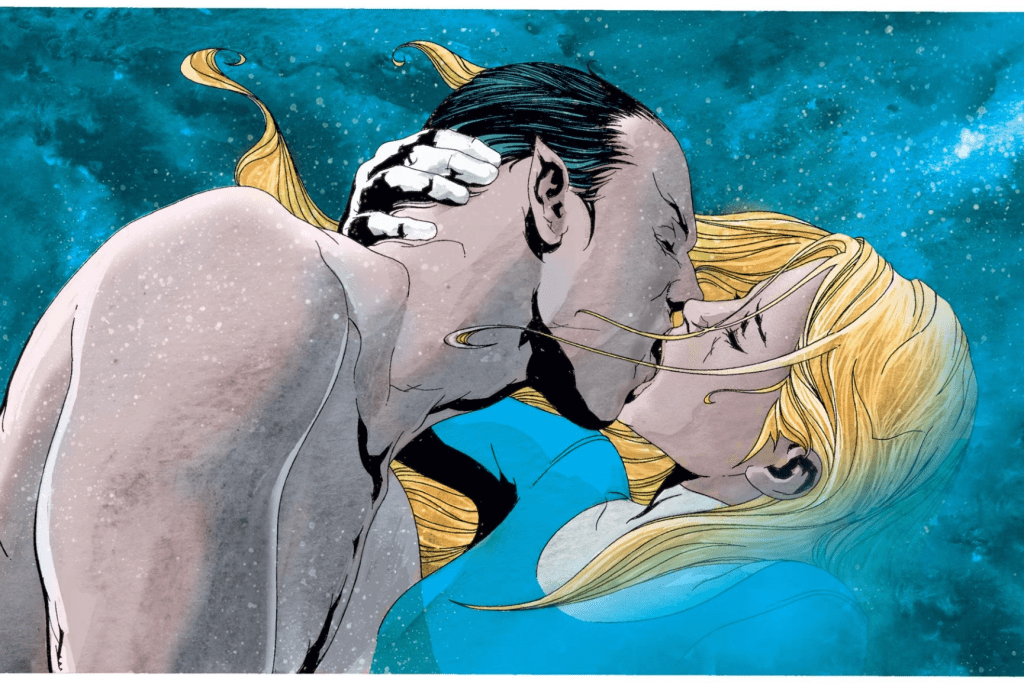
This miniseries is a controversial one for Sue in particular, as I touched on in some of my analysis above. Namely, the infamous panel of her kissing Namor, artwork of which also appeared as the cover of the second issue. In my opinion, people outraged about the fact that this happened likely didn’t read the whole four issues, as by the end it’s rather explicitly obvious that this kiss was the result of Doctor Doom’s manipulation, at least on Sue’s end. Quite simply: Doom literally made her do it. Even on the very page the kiss occurs, Namor states that it might’ve been Doom who even gave them these urges towards each other to begin with. Still, the moment in and of itself was framed oddly and I can’t blame people for not liking it. I don’t like it myself, and it could’ve been written and addressed better, but here we are regardless.
Ben doesn’t really have much to do in this miniseries, as Doom reverts him back to his state before he got his powers, washing away all memory of events that occurred after that fateful first ever issue. This was an interesting idea, but it unfortunately left him out-of-the-know regarding like… everything that was going on in the story. The most poignant moment for me with his character was when he considers his nature as a follower. In the third issue, he reflects:
“I was a soldier, see? I knew it was right for a guy my size to protect people who were too weak to protect themselves, and that’s about the closest thing I ever had to a religion, but… But the truth is I always just went along with anyone who seemed like they had a plan.”
It’s a compelling juxtaposition to have the physically toughest member of the Four be the most malleable, and the most likely to waver in a crisis, at least as it’s presented in these issues. Regardless, we always see Ben come back to himself in the end, as he states “Maybe sometimes a guy does have to face the worst about himself before he can recognize the best. I don’t care if it’s World War Three out there. I’m Ben Grimm, by God.” This is followed up in the fourth and final issue where he is reverted back to his superpowered state as the Thing, and in one of his final moments of the series he gives us a classic “Hey Doc! Wanna guess what time it is?”
Some things really do never get old.

While I love each of the Four for different reasons, my favourite member is Johnny. It might be because of my age, or it might be because I have a tendency to lean towards characters who have a lot more going on underneath than they seem to on the surface.
1234 doesn’t give us much of Johnny, but what it does give us is a brief but intriguing snapshot into the layers of him as a character. When we first see him, he’s being a jackass and poking fun at Ben as he always does, then zips off for a hot date. While in the car with the girl, we see that he’s frustrated—no, angry at the fact that Namor is resurfacing for a potential attack, and this series makes it excessively clear that Johnny hates him. (And who can blame him? I mean, this is the same guy that kidnapped his sister and threatened to kill everyone on earth if she didn’t become his bride.)
The end of the second issue shows us Johnny leaving his date, and in the first panel the girl he’s seeing says “…Johnny, I love what you do to me, but these are third degree burns.” (A joke, or exaggeration—we know that Johnny doesn’t burn people, and we don’t see any injuries on the girl.) He doesn’t respond to this, and instead says that he shouldn’t have been mean to Ben earlier that day, suggesting out loud to himself that he and Ben should go beat up Namor as a form of reconciliation. He then gets out of the car, and tells the girl he was seeing “Take the wheel, baby. It was the car you really wanted, right?” to which she responds with an enthusiastic “Wow! You bet! You’re so cool, Johnny.” The last panel of the page is him walking off solemnly in the rain. As she drives off behind him, all he has to say is “Whatever.”
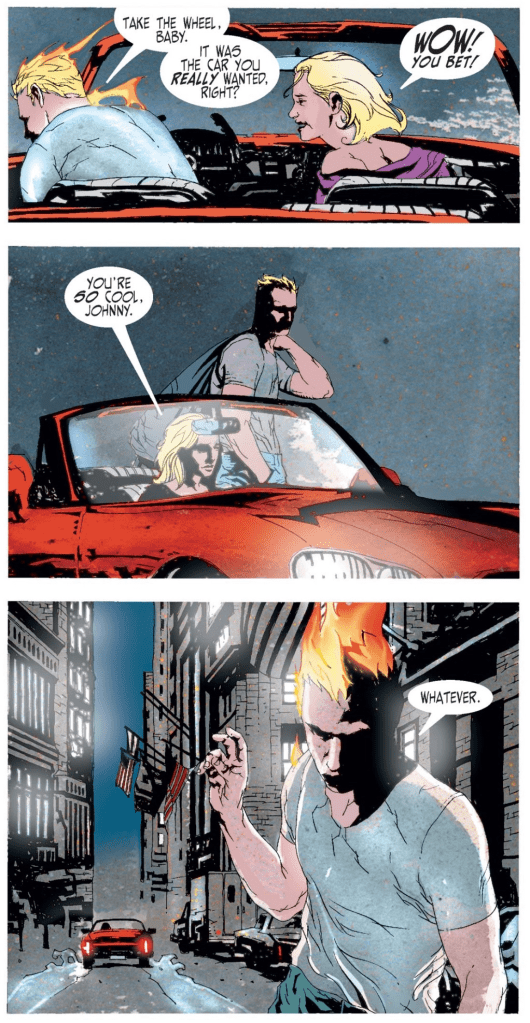
This is one of the key pillars of Johnny’s character, and is the key motive behind the “Johnny Storm is a womanizer” myth. It’s not hedonistic sex he wants, it’s real love, but real romantic love isn’t something that’s ever been successful for him, and it’s something he struggles with believing he deserves. So we get interactions like this: he knew all along that this girl only wanted him for his body and his car, yet he freely gives them both to her anyways, all the while looking miserable. It’s a sad situation, and a sad fate he feels the need to constantly subject himself to.
A common, yet often overlooked, theme with Johnny’s character is bodily autonomy—a subject that I’ll dive in deeper concerning him in later blog posts. The core of this boils down to the fact that ever since he was a teenager, ever since he was 16 years old and got his powers in that fateful accident, his body was never his. His body belonged to the Fantastic Four and the world he was sworn to protect, where as early as Issue #2 of Lee and Kirby’s original run, he, a child, was single handedly ready to make sacrifices on his own that put his life on the line. Beyond that, it’s depicted in a lot of his major or notable relationships over the years, from the Lyja marriage of the 80s and its revisions, to the Daken: Dark Wolverine miniseries from 2009 which sees him with a male love interest for the first time, to as recently as Dan Slott’s late 2010s run, in which he was bound by a metal cuff in a nonconsensual relationship. Again, all of these moments and what they mean are things I’ll surely dive into in essays to come, but as you can see the attitude Johnny has towards himself and what he goes through here is hardly a one off example.
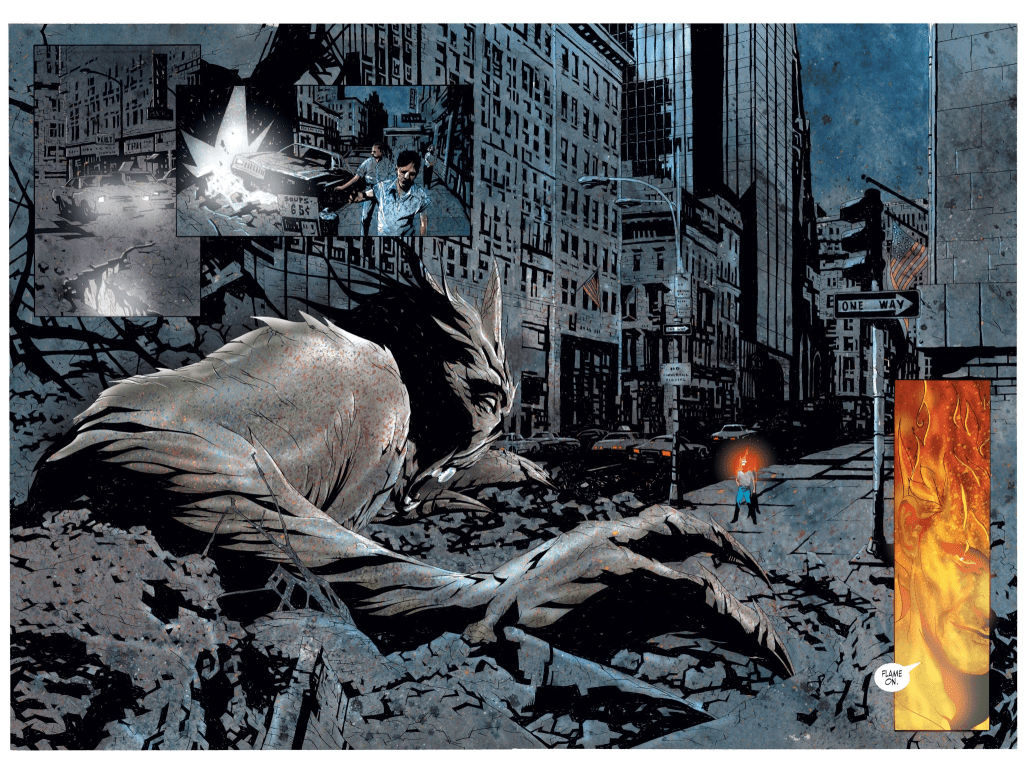
On the next page, he laments “Some nights it’s just too exhausting being me,” but much like Ben, he carries on anyways. Issue two ends with these beautiful pages that I think speak for themselves:
The Art of 1234:
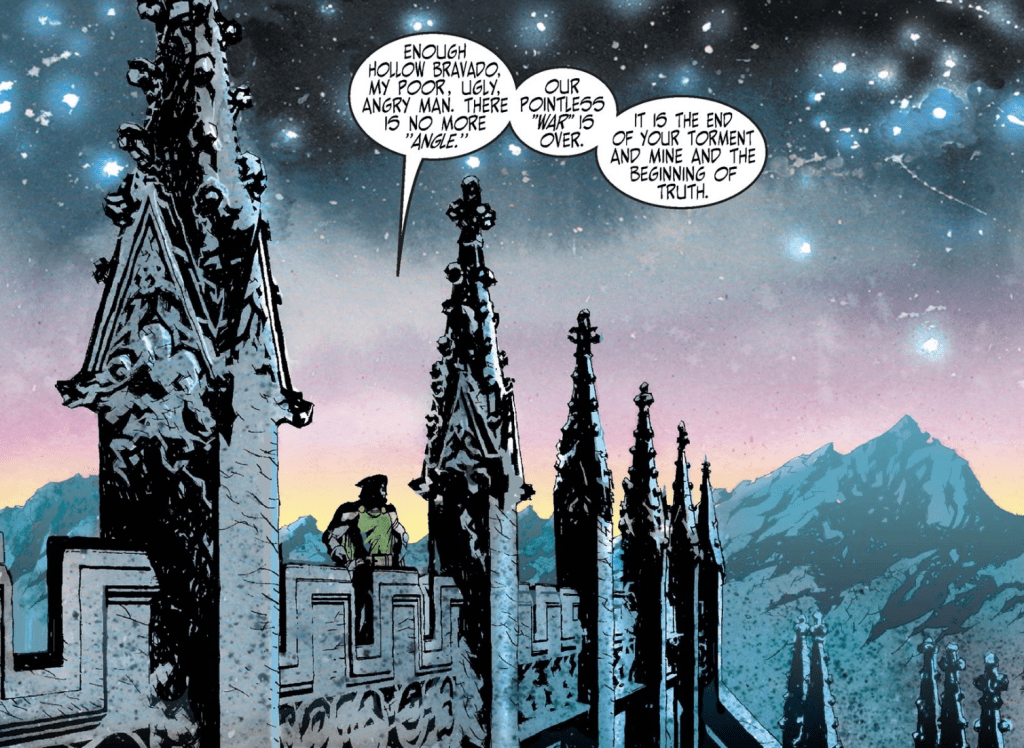
Though every beat of Morrison’s writing didn’t knock it out of the park, it’s safe to say that Jae Lee’s art and José Villarrubia’s coloring certainly did—it was wide, sweeping, and hauntingly beautiful. It truly brought me into the feeling that these issues were not like any Fantastic Four comics I’ve read before.
As a final note, I wanted to take a moment to appreciate the new printing trade cover for this miniseries, pictured below:

What’s striking to me about this is the positioning of the characters in relation to what I presume to be the giant Doombot featured in these issues.
At the very top we have Johnny sitting up with flames tickling the letters of the title. A position like this could be read as one of arrogance or grandeur, but the way he holds onto the Doombot and looks up at the sky with his face hidden from us rather suggests someone who is looking to the stars for an escape.
Next we have Ben below him, holding up the weight of the bot on the right side of the page. He bears it all while looking down, presumably at the life he once had—something we explore in these issues. His downcast gaze also gives us the impression of someone who is carrying not only a physical weight as is in the image, but an emotional one as well.
Sue is positioned in the bottom right side of the page, half curled up into herself. This position suggests a sense of isolation and shame, notably from Reed who is almost directly opposite her on the left, but cut off. It is also interesting to note, that if the bot were to fall, she would be the one it comes down on.
Finally we have Reed, alone in a little cubby at the bottom left of the cover. He works meticulously to hold the bot together, from a position that the others cannot see. This does a wonderful job at capturing the essence of the story, and I cannot commend the artists enough.
Conclusion:
When all is said and done, was Fantastic Four 1234 the “heartfelt tribute to a heroic legacy” that the modern back cover claims it to be? Definitely not, and it fell short in a lot of ways.
Did it give me something to think about, something to write about, and am I glad I experienced it? Absolutely.
And that’s just Fantastic.
Thanks for reading!
𝒜𝓋𝑒𝓇𝓎
 A. N. McKinnon
Leave a comment